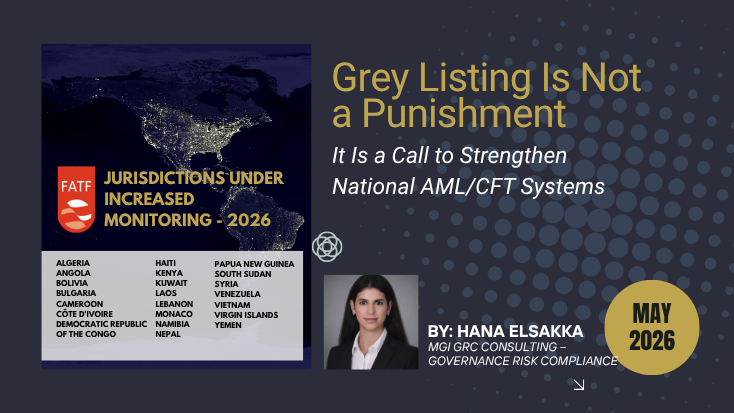
When a country is placed on the Financial Action Task Force (FATF) grey list, the public conversation often turns immediately to reputational damage, economic pressure, and heightened scrutiny from international partners. Headlines frame grey listing as a penalty, a sign that a jurisdiction has fallen behind global expectations. But this interpretation fundamentally misunderstands what grey listing is designed to achieve.
Grey listing is not a punishment. It is a structured and collaborative process that helps jurisdictions strengthen their anti-money laundering and counter-terrorist financing systems. It signals that a country has committed to addressing strategic deficiencies and is actively working with FATF and regional bodies to improve.
Cooperation, Not Isolation
Grey listing does not isolate a country from the global financial system. It does not impose sanctions or label a jurisdiction as high risk. Instead, it places the country under increased monitoring, meaning FATF is working closely with national authorities to strengthen systems, close vulnerabilities, and build long-term resilience. Countries that refuse to cooperate do not appear on the grey list, they appear on the black list. Grey listing is the opposite: a sign of cooperation and commitment.
Effectiveness Over Legislation
The reasons jurisdictions are grey listed are rarely about the absence of laws. Most countries already have AML and CFT legislation in place. The issue is effectiveness. FATF’s methodology focuses on outcomes - whether frameworks work in practice.
A country may have strong laws on paper, but if beneficial ownership information is inaccurate, suspicious transaction reports are low quality, enforcement is weak, or high-risk sectors are poorly supervised, FATF will identify strategic deficiencies. These are not signs of collapse - they are signs of systems that need strengthening..
Grey listing can therefore be understood as a catalyst for reform. It creates political momentum, institutional alignment, and cross agency cooperation that may have been difficult to achieve otherwise. Beneficial ownership transparency is often one of the first areas to improve. Many jurisdictions introduce centralised registries, verification mechanisms, and penalties for non compliance. These reforms significantly reduce opportunities for criminals to hide behind opaque structures.
While grey listing can influence investor confidence and risk assessments, these impacts are manageable and temporary. Many jurisdictions emerge from grey listing with stronger institutions, more transparent financial systems, and improved international credibility.
The reforms undertaken during this period often lead to long-term economic benefits because they reduce systemic vulnerabilities and increase trust in the jurisdiction’s regulatory environment.
Catalyst for Reform
Grey listing creates political momentum, institutional alignment, and cross-agency cooperation that may have been difficult to achieve otherwise. Beneficial ownership transparency is often one of the first areas to improve, followed by stronger supervision of high-risk sectors such as DNFBPs (lawyers, accountants, real estate agents, and company service providers).
Financial intelligence units also benefit through increased resources, better technology, and improved access to data—leading to higher-quality suspicious transaction reports and stronger collaboration with law enforcement.
Grey listing accelerates progress in sanctions implementation. Countries upgrade screening systems, strengthen ownership and control rule enforcement, and improve maritime and trade sanctions monitoring. These enhancements align jurisdictions with global expectations and reduce exposure to sanctions evasion risks.
Pathway to Exit
Exiting the grey list requires sustained and measurable progress. FATF removes jurisdictions only after they complete their action plans and demonstrate that improvements are producing real outcomes. Political commitment, inter-agency coordination, technology investment, and capacity building are essential. FATF looks for evidence - improved STR quality, successful prosecutions, asset recovery statistics, and effective sanctions implementation.
Grey listing should be reframed as an opportunity - a structured improvement pathway that strengthens national resilience, enhances financial integrity, and builds long-term trust with international partners.
Countries that embrace the process emerge with stronger institutions, better governance, and more transparent financial systems. Grey listing is not a verdict - it is a catalyst for modernization and reform.
Lessons from Experience
Many jurisdictions that once faced intense scrutiny are now regarded as regional leaders in financial integrity. Their progress happened because grey listing created national alignment - political leaders, regulators, supervisors, and private sector institutions recognized that strengthening AML and CFT systems was not only a regulatory obligation but a strategic investment in the country’s future.
Shared Responsibility and National Resilience
Banks, fintechs, money service businesses, and DNFBPs are often the first to feel the pressure of increased monitoring - but also the first to benefit from clearer expectations and stronger regulatory guidance.
For citizens, stronger AML and CFT systems protect economies from corruption, tax evasion, organized crime, and terrorist financing. When a jurisdiction exits the grey list, it does so with a stronger foundation for sustainable development and long-term economic resilience.
Conclusion
Grey listing is not a moment of national embarrassment - it is a moment of national opportunity. It is a chance to build systems that are more transparent, more accountable, and more capable of protecting the financial system from abuse.
Countries that embrace this opportunity emerge stronger, more trusted, and better prepared for the challenges of an increasingly complex global financial landscape.